
Why a Smart‑Card Hardware Wallet Feels Like the Future of Everyday Crypto
Whoa — this feels surprisingly familiar. I was juggling a phone, a seed phrase, and a plastic card last week. My instinct said somethin’ felt off, and I couldn’t shake it. Initially I thought a metal wallet or a seed on paper was plenty, but then I realized that usability and everyday friction are just as important as cryptographic security, especially for people who don’t geek out on key management. On one hand a hardcore hardware device solves cold storage, though actually the experience of carrying, tapping, and paying from a smart‑card changes behavior in subtle ways that improve safety over time.
Really — this is shockingly convenient. Contactless payments have trained people to tap and go, so adding crypto to that flow makes sense. My first impression was emotional: wow this is slick and kinda futuristic. Then the slow part of me kicked in and started asking questions about attack surfaces, firmware updates, and who holds the keys when things go sideways. I tried to think like an adversary, and that pushed me to test worst-case scenarios and real usability failures.
Wow — I got surprised by one simple detail. The smart‑card form factor forces minimal UI, and that reduces a lot of the human error I keep seeing in seed‑phrase backups. Developers often overcomplicate key import flows, and people skip steps because they’re bored or distracted. Something as simple as a tap-to-authenticate flow makes recovery habits better by design, not by lecture. That behavioral nudge is subtle but very very important for long‑term security.
Okay, so check this out — the pairing with a mobile app is where the magic is. The phone handles the interface and network traffic while the card keeps the keys offline and unreachable. I’m biased, but a system that separates UI from key custody feels like the right compromise for most users. Seriously? Yes, because it reduces phishing risk without trapping people in weird vaults, though it does mean you must trust the mobile app to be well‑built. Actually, wait—let me rephrase that: you trust the app for convenience, not for custody.
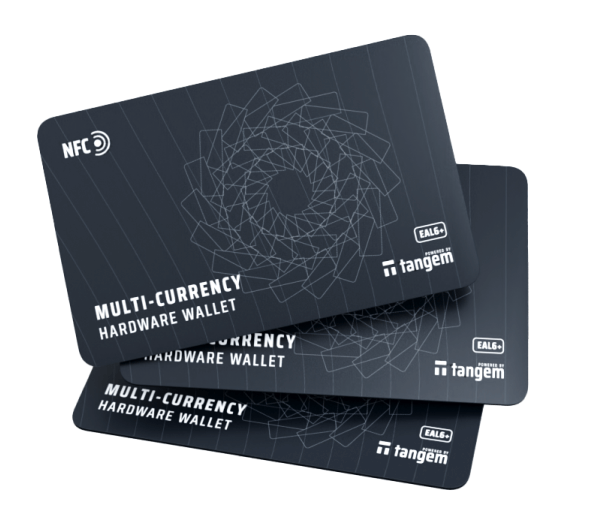
Try a smart card approach like the tangem hardware wallet
Check this out—if you’re curious about a real product that nails the smart‑card idea, look at the tangem hardware wallet, which bundles contactless convenience with offline key storage in a slim card you can slip in your wallet. I spent a few days using one and found that the friction curve is so low that I actually moved routine payments to crypto more often, which is both exciting and a little unnerving. The tradeoffs are obvious: you give up some advanced features and multi‑sig complexity for everyday ease, and that’s a conscious decision, not a bug. For many people the balance will be right, though power users will still want their multisig rigs and air‑gapped setups.
Hmm — but there are limits to this happiness. Smart‑card wallets rely on secure elements and vetted firmware, so supply chain and update channels become critical. Developers have to thoughtfully design OTA updates or signed firmware flows; otherwise the model breaks. I’m not 100% sure every vendor will keep that discipline, and that concern is why audits and community scrutiny matter. In practice, credible devices have layers of attestations and recovery flows that are practical for non‑technical folks.
Here’s what bugs me about the market right now. Too many vendors promise “bank‑grade security” with marketing gloss and little transparency about key handling. People latch on to brand words and skip the details, and that leads to bad outcomes. My instinct said that social education must accompany any new form factor, and I watched real users make predictable mistakes even with great devices. Education is necessary but not sufficient; the product must anticipate mistakes and prevent them.
Hmm — I should admit a little bias. I love physical designs that feel like everyday objects because adoption follows from normalcy. I also admit I’m not the best at storing tiny recovery tokens, and that influenced my testing. On the flip side, some collectors and advanced hodlers will want cold‑storage only options and multiple redundancies, and they should absolutely keep those. For broader adoption, though, friction is the enemy and the smart‑card approach kills a lot of friction without sacrificing the cores of secure custody.
Seriously — think about airport lines and coffee shops. Tapping a card is less conspicuous than pulling out a ledger device and fumbling passphrases. There are social engineering angles in public, and minimizing exposure matters. That said, public settings also increase the need for quick lockouts, PINs, and plausible deniability features—things designers sometimes overlook. I tried forcing scenarios where I had to quickly revoke a session, and the best devices handled that smoothly, while weaker ones left me anxious and exposed.
Okay — let’s be pragmatic about risks and benefits. Cold storage on metal still wins for long‑term offline holdings and proof of backup integrity, and that’s not changing. But for daily spending and short‑term custody the smart‑card model is a clear improvement. Adoption will hinge on three things: trustworthy firmware, good recovery UX, and transparent supply chains. If vendors nail those, we get secure and usable crypto for people who just want to pay a barista without reading a whitepaper.
FAQ
How does a contactless hardware wallet actually keep my keys safe?
The card stores private keys in a secure element that never exposes them; the mobile app sends signing requests which the card approves on tap, so the key never leaves the hardware. That separation reduces phishing and remote compromise risks, though you still need good recovery strategies and to verify firmware provenance. Also, never share your PIN or recovery phrase, and treat the recovery process like a critical safety step rather than a chore.
Can I lose the card and still recover my funds?
Yes, most implementations include a backup or recovery phrase that you store offline; some offer programmable recovery that ties to multi‑device or multi‑party schemes. The user flow needs to be clear and tested, because in the real world people skip steps and assume somethin’ will just work. Be deliberate about your recovery choices and test them before you trust large sums.
Các Thông Tin khác
| Giá | Hướng | ||
|---|---|---|---|
| Diện tích | m2 | Đường trước nhà | m |
| Chiều dài | m | Pháp lý | |
| Chiều rộng | m | Số lầu | |
| Chỗ để xe | Số phòng ngủ | ||
| Địa chỉ | |||
