
Why I Keep Going Back to Solscan — a Real User’s Take on Solana Analytics
Okay, so check this out—Solscan often gets glossed over in favor of flashy dashboards, but I keep coming back. Wow! The first thing that hits you is speed. Solana moves fast, and a slow explorer feels useless; Solscan usually keeps up, which matters a lot when you’re tracing a memecoin pump or debugging a failed transaction.
Whoa! At first I thought all explorers were pretty much the same. Hmm… my instinct said otherwise after a few hands-on sessions. Actually, wait—let me rephrase that: the differences are subtle but meaningful, especially for power users who live in the weeds of block data. On one hand, UIs can be pretty; though actually, accurate parsing and timely indexing are what make or break an explorer for heavy usage.
Here’s what bugs me about some analytics tools: they pretend to explain causality. Seriously? Transactions and program interactions are messy and context-dependent. Solscan doesn’t oversimplify as much. It gives raw traces, decoded instructions and token balances in ways that are practical for troubleshooting or on-chain sleuthing—things I’ve used to resolve wallet sync issues and to confirm program upgrades (oh, and by the way, I once found a mis-specified authority key that would’ve cost someone big time).
I like that Solscan balances depth with approachability. Short summary panels help you scan accounts quickly. Medium-level detail sits one click away. If you want instruction-level traces, they’re there—decoded into human-friendly names when possible, but the raw instruction bytes are still accessible for audit-y folks.
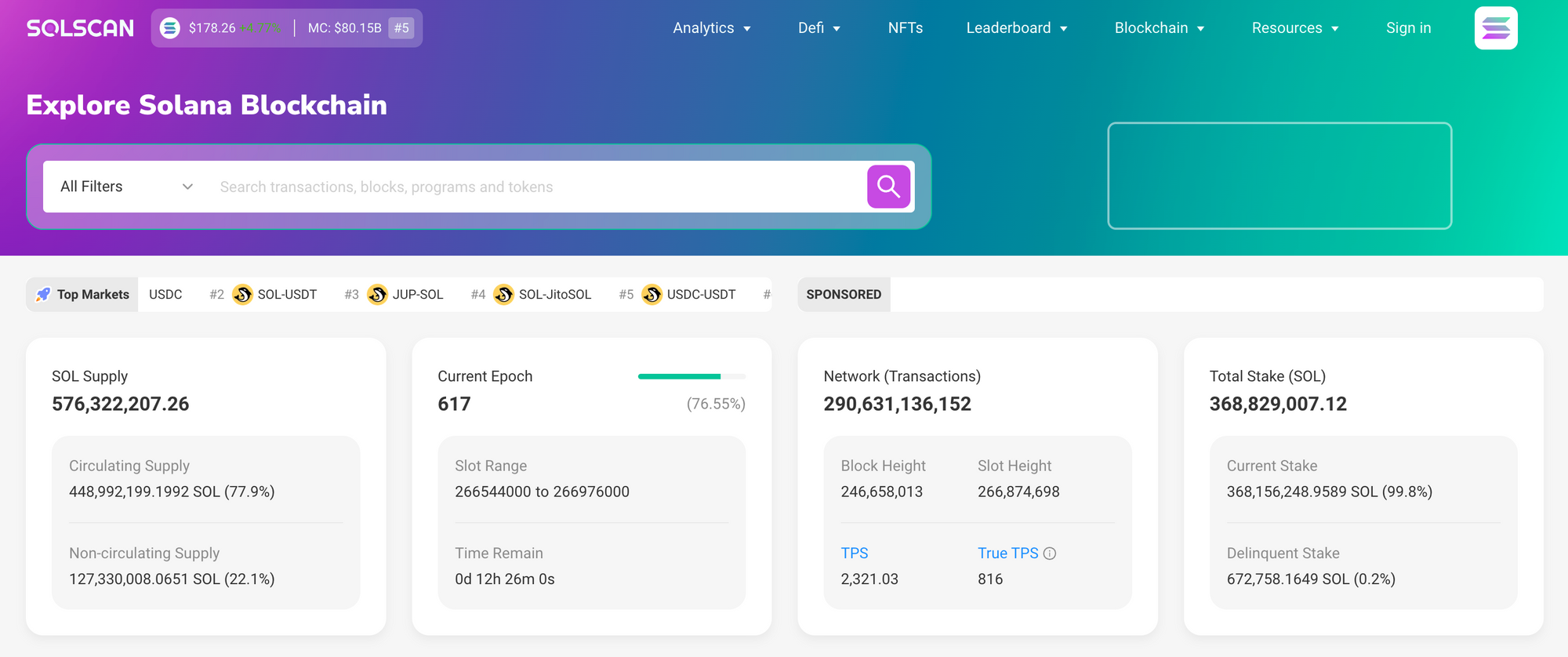
How I use Solscan in real workflows
In my day-to-day I do a mix of things: wallet forensics, token listings sanity checks, and monitoring cluster health during stress tests. Wow! For forensic drills I usually start with a transaction signature and follow the instruction sequence. Then I look at pre/post balances and mint authority changes. Sometimes I lean on the CSV export to feed my own scripts, though Solscan’s CSVs are often good enough out of the box.
One practical tip: when you’re investigating a program call that failed, check the inner instructions and logs before assuming the program is buggy. My instinct said “revert” once, but logs showed an SPL token account rent exemption failed—human error, not code failure. That nuance saves time. If you want to try Solscan yourself, you can find the official site here.
Solscan’s token and NFT pages are also solid. They show holder distributions, transaction histories and—critically for marketplace operators—royalty info where available. This helped a friend (Midwest dev, very scrappy) decide whether to list a collection; we used holder concentration metrics and recent volume trends to gauge liquidity and risk. Not perfect—on-chain ownership doesn’t equal active holders—but it’s a useful signal.
I’m biased, but the performance metrics page is one part that I appreciate more than most. Cluster TPS and block time trends are front-and-center. If you’re running bots or liquidity strategies, small latency differences can cascade into missed rebalances or slippage. Solscan’s telemetry isn’t the only source, but it gives a quick read without logging into a node.
Sometimes things annoy me. The UI can be inconsistent between features. There are tiny UX warts that make me mutter under my breath—somethin’ like misaligned filters or confusing terminology. Still, overall reliability and the depth of decoded data make up for the occasional friction.
Solscan vs other explorers — a few tradeoffs
Short answer: choose tools by task. Wow! For quick signature lookups or token balance checks, many explorers are fine. For decoded program traces and owner authority histories, I reach for Solscan. For deep, historical analytics or custom cohort analyses, you might pair Solscan with third-party analytics platforms or your own database.
On one hand, Solscan is faster and often fresher than some alternatives. On the other hand, dedicated analytics suites provide custom dashboards, cohort retention stats, or sophisticated heuristics for whale detection—features that Solscan doesn’t aim to be. So it’s less about one being “better” and more about which tool fits the job.
And here’s an honest aside: sometimes the data you need isn’t on-chain, or it requires linking off-chain metadata. That complicates everything. I once spent hours tracing a failed mint and realized the issue was an off-chain metadata URI returning a 403. Tech is messy. Life is messy.
FAQ
How reliable is Solscan for legal or audit work?
It’s reliable as an on-chain evidence source—transaction signatures, timestamps, instruction traces are immutable on Solana. However, audits usually require corroborating node logs or backups and a formal process. Use Solscan as a starting point, not the sole legal record.
Can I export large datasets from Solscan?
Yes, to an extent. CSV exports and API access cover many use cases, but for very large historical pulls you might prefer running an indexer or using a dedicated archival service. Solscan is great for targeted pulls and ad-hoc analysis.
Does Solscan support decoded program instructions for custom programs?
They support many common programs out of the box and decode frequently used instruction sets. For niche or private programs you may see raw bytes; in those cases, pairing decoded traces with your own decoding logic is the usual approach.
Final thought: Solscan feels like a good neighbor in the Solana tooling ecosystem—helpful, fast, and increasingly mature. Really? Yep. I still check a node when I need ultimate certainty, and I keep a few other explorers bookmarked for cross-checks. But for everyday Solana analytics and quick forensic work, Solscan is one of the first stops on my list. I’m not 100% sure about every edge case, but for most problems it gets me 80% of the way there, which is often enough to make the right call.
Các Thông Tin khác
| Giá | Hướng | ||
|---|---|---|---|
| Diện tích | m2 | Đường trước nhà | m |
| Chiều dài | m | Pháp lý | |
| Chiều rộng | m | Số lầu | |
| Chỗ để xe | Số phòng ngủ | ||
| Địa chỉ | |||
